
Missed-Call Text Back for Contractors: How It Works
This post is part of ScaleFoundry's lead follow-up guides for DMV trades.
The short answer
Missed-call text back is a reply text sent from your business number when a customer call goes unanswered. The text names your company, says you missed the call, and asks how you can help, or offers a link to book a time. A person on your team should still call back as soon as someone is free. This article explains how the process works, what the first text should say, and the consent and opt-out basics you should review before you turn it on.

What is missed-call text back for contractors?
Missed-call text back is a reply text sent from your business number when a call to your company goes unanswered. The message names your company, says you missed the call, and asks how you can help, or points to a booking link. The thread stays in your inbox until you can call back.
It is a common part of lead follow-up for contractors in DC, Maryland, and Virginia. The goal is to stay in the conversation while you are on a job. The text is not a close. It is a first touch so the caller does not hang up and dial the next company on the list.
This helps trades that live on the phone, including roofing, HVAC, plumbing, cleaning, landscaping, and general contracting. An after-hours no-heat call and a roof inspection request are not the same job, but both start with someone reaching you and not getting through.
How does missed-call text back work?
When an inbound call is missed, your system sends one text from the business number right away. The customer can reply or use a booking link if you include one. The text and call record should land in one inbox. Someone on your team still calls back as soon as they can.
A simple path looks like this:
| Step | What happens | Who does it |
|---|---|---|
| 1. The call is missed | An inbound call to your published number is not answered and is logged as missed. | Your phone system |
| 2. One text goes out | A message is sent from your business number within moments, not hours later. | Your texting setup |
| 3. The customer can respond | They reply with what they need, or they pick a time from a booking link if you included one. | The customer |
| 4. It lands in one inbox | The call, the text thread, and any form or chat leads sit in the same place. | Your follow-up system |
| 5. A person follows up | Someone calls back, books the visit, or flags an urgent job. If there is no reply, one reminder is enough, then you stop. | Your team |
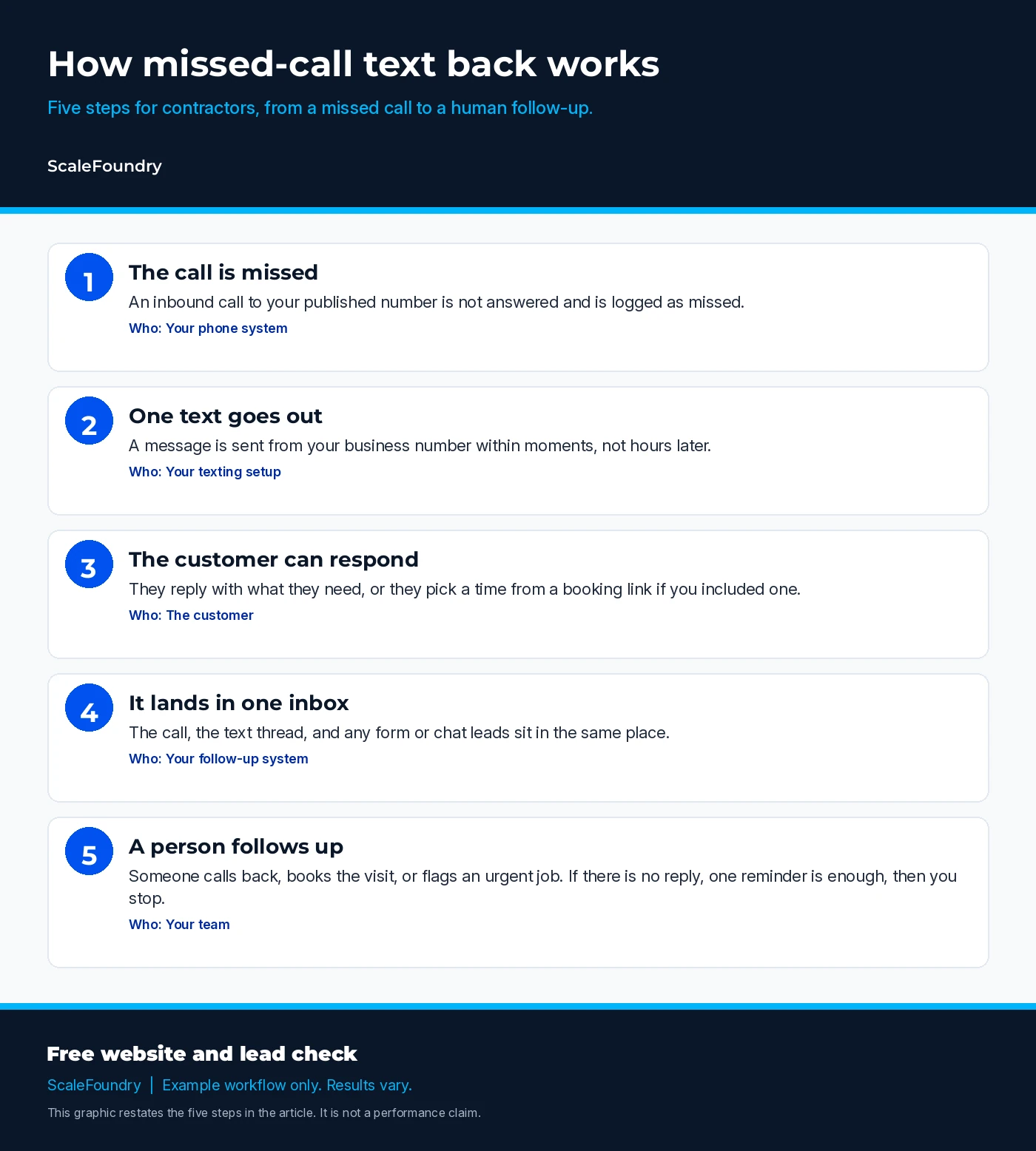
Speed matters because the customer is still holding the phone they just used. Waiting until the next morning often means they have already called someone else. That is the same pattern described in ScaleFoundry's overview of how leads are captured and booked.
If there is no reply, do not keep sending messages. One later reminder, later the same day or the next business morning, is enough. Then wait for them to reach out again.
Why do home-service contractors miss calls?
Many owners and crews are on a job when the phone rings, so the call goes to voicemail. Invoca, using its platform data in a May 23, 2024 article, reported that 27 percent of calls to home services businesses were not answered, and that less than 3 percent of callers sent to voicemail left a message.
Those figures come from Invoca's May 23, 2024 article, based on that company's platform data, not on ScaleFoundry clients. Your share of missed calls will differ by crew size, hours, and how many people can pick up.
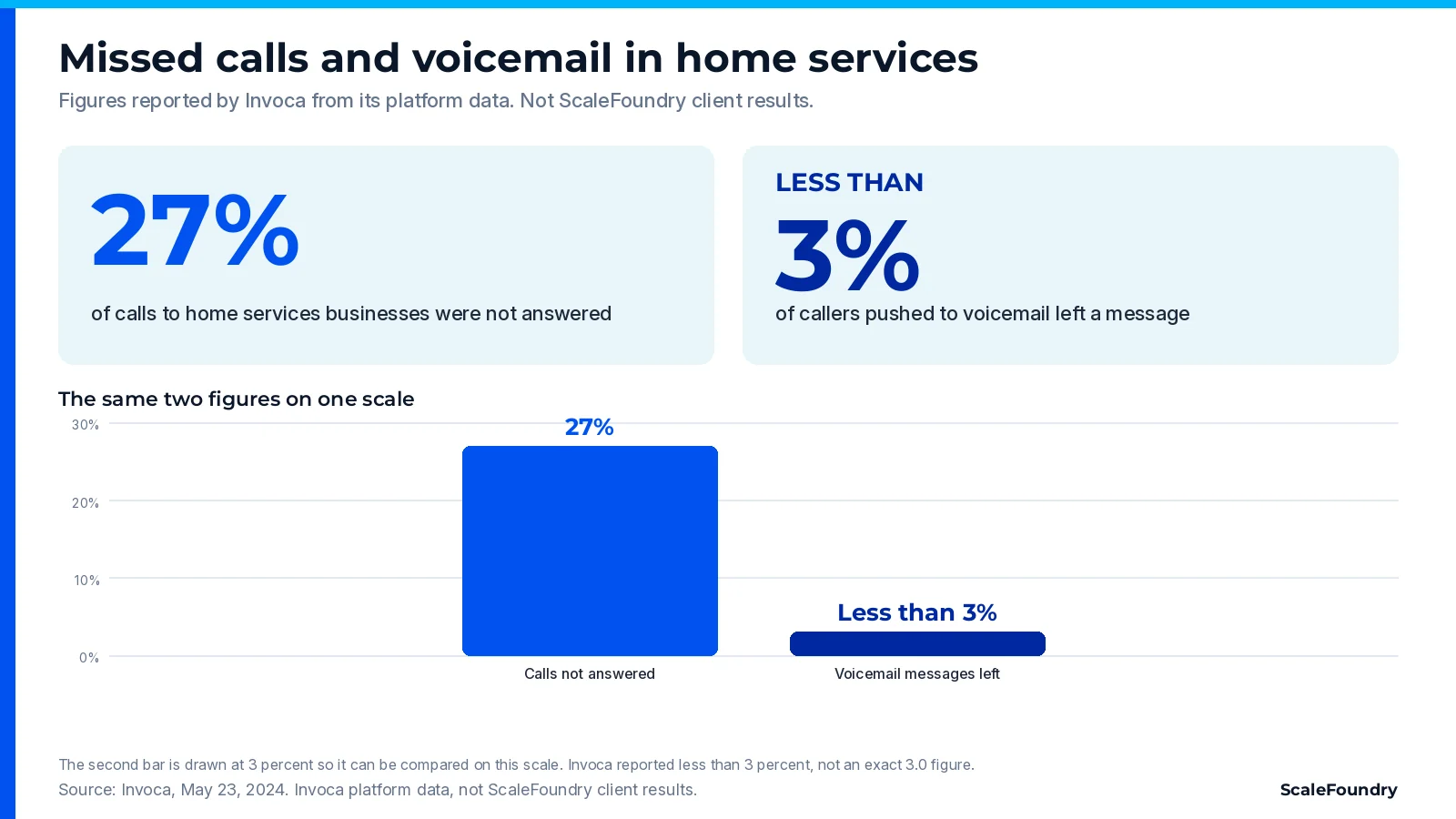
A missed call is often a job you already paid to attract. Voicemail is a weak backup if almost no one leaves a message. A reply text gives them a way to stay in touch without waiting on hold or recording a voicemail.
What should the first text say?
Keep the first text a reply, not a sales pitch. Name the business, say you missed the call, and ask what they need. If you include a booking link, say what the link is for. Add a simple opt-out line, such as Reply STOP to opt out. Leave discounts and other marketing out of that first message.

Here is a labeled example, not a required script and not a promise of any result:
Hi, this is [Your Company]. We missed your call. What's going on, and how can we help? You can also pick a time here: [booking link]. Reply STOP to opt out, HELP for help. Message and data rates may apply.
A shorter version, closer to the sample thread on the ScaleFoundry homepage, looks like this:
Hi, it's [Your Company]. Sorry we missed your call. What's going on? You can also grab a time here: [booking link].
If you use the shorter version, still make opt-out language easy to find in the first text, or in the form your provider requires. Name the business so the customer knows who is writing. Use the number people already associate with you.
Do not load the first text with a seasonal special, a financing offer, or a long menu. That reads as marketing, and marketing texts have a higher consent bar, which is covered below.
What should you do after the customer replies?
Treat the reply as a live lead. If the problem is urgent, get a person on the phone as soon as you can. If they want an estimate, offer times or point them to the booking link. Keep the thread in the same inbox as the call. A short confirmation text is fine. Then follow up in person.
Sort replies the way your trade actually works. A water leak, a no-heat call, or a tarp request should jump to the front. An estimate request can go to the next open inspection slot. If they ask about hours or service area, answer and offer a time to talk.
The inbox only helps if someone is watching it. Assign a person, even if that person is you, and set a rule for after-hours messages so they are not ignored until Monday.
This is also where a wider contractor lead follow-up system matters: the missed call, the text, and the booking should not live in three different apps.
For the larger process around estimates, reviews, and keeping leads in one place, see our contractor lead follow-up services.
Do you need consent to send a missed-call text?
This is not legal advice, and rules can change. The FCC says autodialed texts to a mobile phone generally need the owner's prior consent, unless they are for an emergency. Commercial texts require written consent. Consent for informational texts may be oral. Keep a missed-call reply about that call, and get written consent before marketing texts.
The Federal Communications Commission explains this in its consumer guide, Stop Unwanted Robocalls and Texts (page reviewed February 27, 2026). In the robotexts section, the FCC says it bans text messages sent to a mobile phone using an autodialer unless the phone owner previously gave consent, or the message is sent for emergency purposes. The same guide says commercial texts require written consent, and that for informational texts, consent may be oral.
A customer who just called you is reaching out. That is different from buying a list and texting strangers. It does not automatically mean every automated follow-up is fine. If your system sends the text automatically, treat it as the kind of message the FCC is talking about, and get advice from a lawyer who knows the Telephone Consumer Protection Act and the states you serve.
Practical habits that stay aligned with that guidance:
- Make the first text a reply to the call they placed, not a promotion.
- Get prior express written consent before you send marketing texts, offers, or unrelated campaigns. Written consent can be electronic, such as an unchecked box on a form, when it is set up correctly.
- Do not make consent a condition of buying your service.
- Link to your privacy policy and SMS terms wherever you collect a number for texting. ScaleFoundry's public pages for this are the Privacy Policy and SMS Terms.
- If you work in Washington, DC, Maryland, or Virginia, ask counsel whether state rules add anything on top of federal law. This article does not attempt to restate those state rules.
How do opt-outs work for business texts?
Customers may opt out at any time and in any reasonable way. A 2024 FCC rulemaking says a reply of STOP, or similar words such as QUIT, END, REVOKE, OPT OUT, CANCEL, or UNSUBSCRIBE, is a reasonable way to revoke consent. Honor the request promptly. One confirmation text is allowed.
That list and the timing rule come from the FCC's March 5, 2024 Federal Register notice, Strengthening the Ability of Consumers To Stop Robocalls. The Commission also said callers must honor a consent revocation within a reasonable time, not to exceed ten business days from receipt, and that senders may send a one-time text confirming that no further messages will be sent.
Ten business days is the outer limit in that rule, not a goal. Stop further texts as soon as the request comes in. If the person uses other words that a reasonable person would read as "do not text me," treat that as an opt-out too. After they opt out, do not text that number for that program unless they clearly opt back in.
The FCC consumer guide also states that a person may opt out of a robocall or robotext at any time and in any reasonable manner, even if they previously gave consent. Build STOP and HELP into the program, and make sure those replies actually work in a live test, not only on paper.
What is A2P 10DLC, and why does it matter?
A2P 10DLC is the U.S. carrier system for application-to-person texts sent from regular 10-digit business numbers. The Campaign Registry describes 10DLC as a channel where brands and their messaging providers are verified before messages are allowed. You register as a Brand through your messaging provider, not directly with The Campaign Registry.
The Campaign Registry is the registration layer carriers use for this traffic. On its site, it says that if you are a company wanting to use SMS to communicate with your customers, you are considered a Brand, and that direct registration with The Campaign Registry is not available for Brands. You work with a registered messaging service provider, which handles registration for you.
In plain terms, if you send business texts from a 10-digit number, your provider should register your business and the use case before you rely on those texts to reach inboxes. Unregistered or poorly described campaigns are more likely to be filtered or blocked. Registration is a carrier requirement. It is not a substitute for TCPA consent.
Have your provider describe the use case honestly, including missed-call replies, appointment messages, and any marketing you actually send. Keep sample messages, opt-in language, and opt-out language consistent with what you send.
How is missed-call text back different from voicemail or an answering service?
Voicemail asks the caller to wait and leave a message, and many people will not. A text arrives on the same phone they just used, so they can reply in a few words or book a time. An answering service may pick up live, which is different. Text back is a safety net, not a substitute for calling back.
You can use these tools together. Some shops keep a live person on the line during business hours and use text back when a call is missed. What you advertise has to match what you actually staff. If your website and Google listing say you close at 6 PM, do not promise 24-hour service in the text unless that is true.
Only send a booking link that shows real availability. A dead link or a stale calendar is worse than no link.
What should a DMV contractor set up first?
Start with the number you publish, a way to see missed calls, and a registered 10DLC setup through your provider. Write a short first text with opt-out language, and decide who calls back and how quickly. Put calls, texts, and form leads in one place. Then test the text, the inbox, the booking link, and the STOP path.
A first-week checklist:
- Confirm the number on your website and Google profile is the number that will send and receive the texts.
- Register the brand and campaign with your messaging provider under A2P 10DLC.
- Write the first text and a one-reminder follow-up. Keep marketing out of both until you have written consent for it.
- Decide who watches the inbox during the day, and what happens after 6 PM.
- Miss a call from a second phone. Confirm the text arrives, the thread is visible, the booking link works, STOP is honored, and HELP returns a useful reply.
- Only then turn it on for real customers.
If you want a second set of eyes on how your calls, texts, and estimates are handled today, ScaleFoundry will run a free website and lead check with you.
Get a free website and lead check
Get a free website and lead check. We'll look at how your calls, texts and estimates are handled today and tell you which plan fits. If none of them fit, we'll say so.
Rather talk now? Call 301-321-8805, Mon-Fri 8am-6pm ET.
ScaleFoundry is a service-area business based in Upper Marlboro, Maryland, serving contractors in DC, Maryland, and Virginia, plus remote clients nationwide.
About the author
Raymond Donato is the founder of ScaleFoundry, an AI marketing and automation agency for home-service contractors in DC, Maryland, and Virginia. He has 24 years of cybersecurity and communications experience. He works with owners who lose jobs to missed calls and weak follow-up.
Questions
What is missed-call text back for contractors?
Missed-call text back is a reply text sent from your business number when a call to your company goes unanswered. The message names your company, says you missed the call, and asks how you can help, or points to a booking link. The thread stays in your inbox until you can call back.
How does missed-call text back work?
When an inbound call is missed, your system sends one text from the business number right away. The customer can reply or use a booking link if you include one. The text and call record should land in one inbox. Someone on your team still calls back as soon as they can.
Do you need consent to send a missed-call text?
This is not legal advice, and rules can change. The FCC says autodialed texts to a mobile phone generally need the owner's prior consent, unless they are for an emergency. Commercial texts require written consent. Consent for informational texts may be oral. Keep a missed-call reply about that call, and get written consent before marketing texts.
How do opt-outs work for business texts?
Customers may opt out at any time and in any reasonable way. A 2024 FCC rulemaking says a reply of STOP, or similar words such as QUIT, END, REVOKE, OPT OUT, CANCEL, or UNSUBSCRIBE, is a reasonable way to revoke consent. Honor the request promptly. One confirmation text is allowed.
What should a DMV contractor set up first?
Start with the number you publish, a way to see missed calls, and a registered 10DLC setup through your provider. Write a short first text with opt-out language, and decide who calls back and how quickly. Put calls, texts, and form leads in one place. Then test the text, the inbox, the booking link, and the STOP path.
Serving Upper Marlboro? See contractor marketing in Upper Marlboro, MD.
Want this set up for your crew?
Get a free website and lead check