
SEO vs AEO vs GEO for Small Businesses
This post is part of ScaleFoundry's lead follow-up and visibility guides for DMV trades.
The short answer
SEO, AEO, and GEO are related ways to help people find your business when they search or ask a question. SEO helps your pages appear in search results. AEO and GEO focus on being used in a direct answer or in an AI-written reply, including Google AI Overviews, ChatGPT, and Perplexity. They are not a replacement for SEO, and no one can guarantee a ranking or an AI citation.
This guide explains the terms in plain English, how they differ, why AI answers matter now, and what a small home-service business in DC, Maryland, or Virginia can do first.

What is SEO, AEO, and GEO?
SEO helps your pages appear in search results so people can click through to your site. AEO, or answer engine optimization, aims to have your content used as a direct answer, such as a featured snippet or an AI Overview. GEO, or generative engine optimization, aims to have your business named or cited in an AI-written answer.
The names sound like three separate products. They are not. They describe related outcomes of the same kind of work: a site that can be crawled, pages that answer real questions, and business facts that stay consistent.
SEO, or search engine optimization, is the older and broader term. It covers the technical and content work that helps a search engine find, understand, and rank your pages. For a contractor, that usually means service pages, a clear service area, reviews, and a complete Google Business Profile.
AEO came from the idea of "answer engines": featured snippets, People Also Ask boxes, and voice answers that read a short reply out loud. The same idea now includes AI Overviews that sit above the usual list of links.
GEO is a newer label for visibility inside answers that a generative system writes. The term comes from a 2023 research paper, GEO: Generative Engine Optimization, which described a way to study whether a source appears in those answers. Agencies later adopted the acronym as a marketing term. There is no single industry standard for where AEO ends and GEO begins, and the two are often used interchangeably.
If you run a crew in the DMV, you do not need to buy three separate strategies. You need to understand what each term is pointing at, then do the work in a sensible order.
How do SEO, AEO, and GEO differ?
They differ in the result they aim for, not in a separate skill set. SEO is about ranking a page in a list of results. AEO is about being used as the short, direct answer. GEO is about being named or cited when an AI system writes a reply. All three rely on clear, crawlable pages with consistent facts.
| SEO | AEO | GEO | |
|---|---|---|---|
| Full name | Search engine optimization | Answer engine optimization | Generative engine optimization |
| Main goal | Rank a page so people can click through | Be used as a direct answer | Be named or cited in an AI-written reply |
| Where it shows up | Google and Bing results, including local results | Featured snippets, voice answers, and short AI answers | ChatGPT, Google AI Overviews and AI Mode, Perplexity, and similar tools |
| What you do | Indexable pages, useful content, links, reviews, and a current Google Business Profile | Answer common questions clearly, near the top, in plain text | Do the SEO and AEO work, and keep your business facts consistent everywhere |
| Can it be guaranteed? | No | No | No |
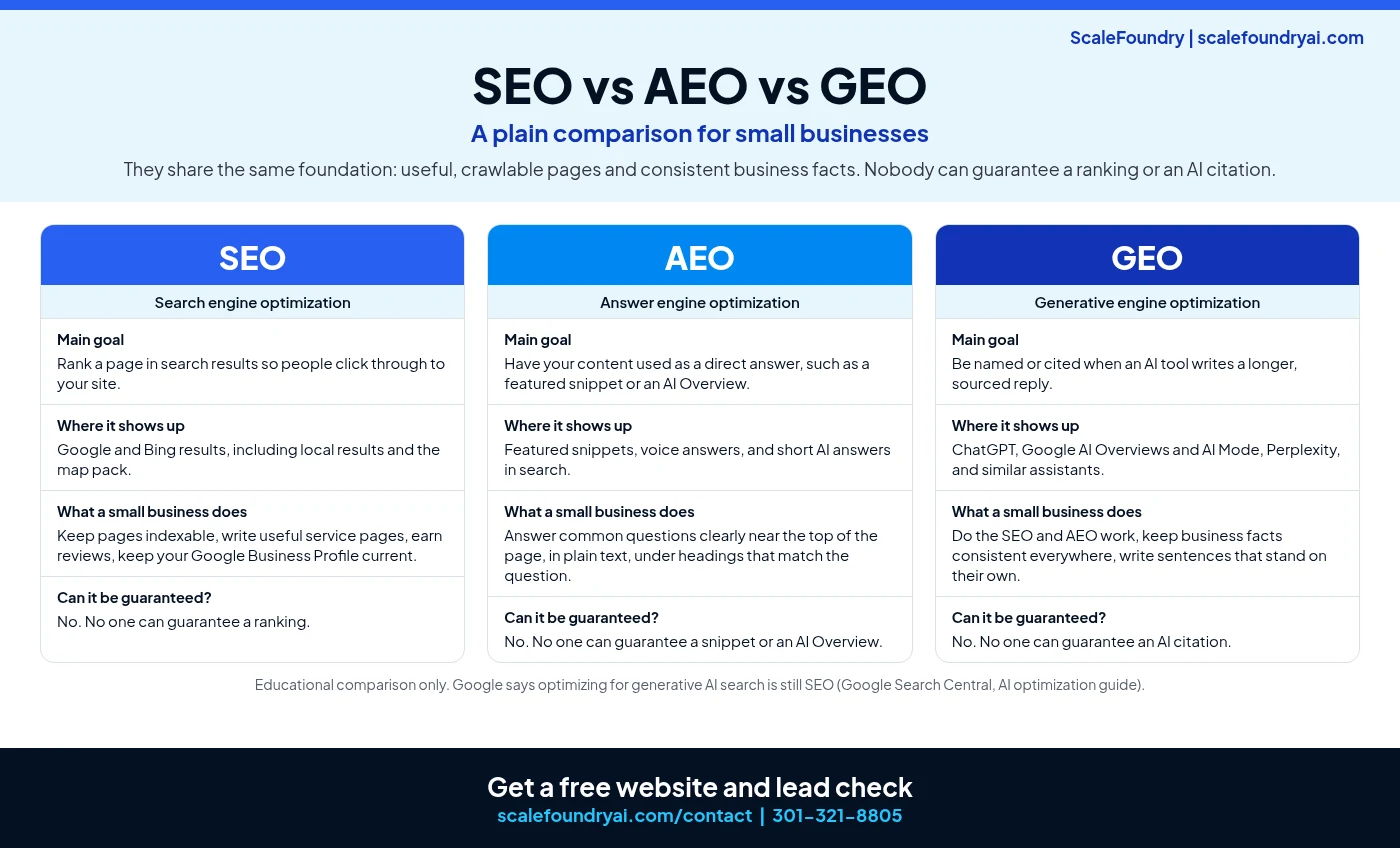
The overlap matters more than the labels. A page that ranks can also be the source of a snippet. A page that answers a question clearly can also be cited in a longer AI reply. Google says this directly. In its guide to optimizing for generative AI features on Google Search, Google writes that "AEO" and "GEO" are terms people use for work aimed at AI search, and that from Google Search's perspective, optimizing for generative AI search is still SEO.
If an agency tells you that GEO replaces SEO, ask how its plan differs from the foundations already in that guide: crawlable pages, useful content written for people, and business details that match what customers see.
Why do AI search answers matter for a small business now?
They matter because many customers now read a short answer before they click a link. In September 2026, OpenAI said ChatGPT had 1.2 billion weekly users. In May 2026, Google said AI Overviews had over 2.5 billion monthly active users. If you are missing from that answer, or described poorly, the customer may never reach your site.
Those figures come from the companies themselves. OpenAI's DevDay 2026 recap, dated September 29, 2026, refers to "our collective 1.2B weekly users." In Sundar Pichai's I/O 2026 remarks, published May 19, 2026, he said AI Overviews had over 2.5 billion monthly active users, and that AI Mode had passed 1 billion monthly active users in its first year. In Alphabet's Q3 2026 earnings remarks on October 28, 2026, he said the Gemini app was at one billion users, and that queries in AI Mode are on average three times longer than traditional searches.
None of those numbers are ScaleFoundry client results, and they do not tell you how often a homeowner in Bowie or Arlington will ask an assistant for a roofer. They do show that AI answers are no longer a side experiment. People use them.

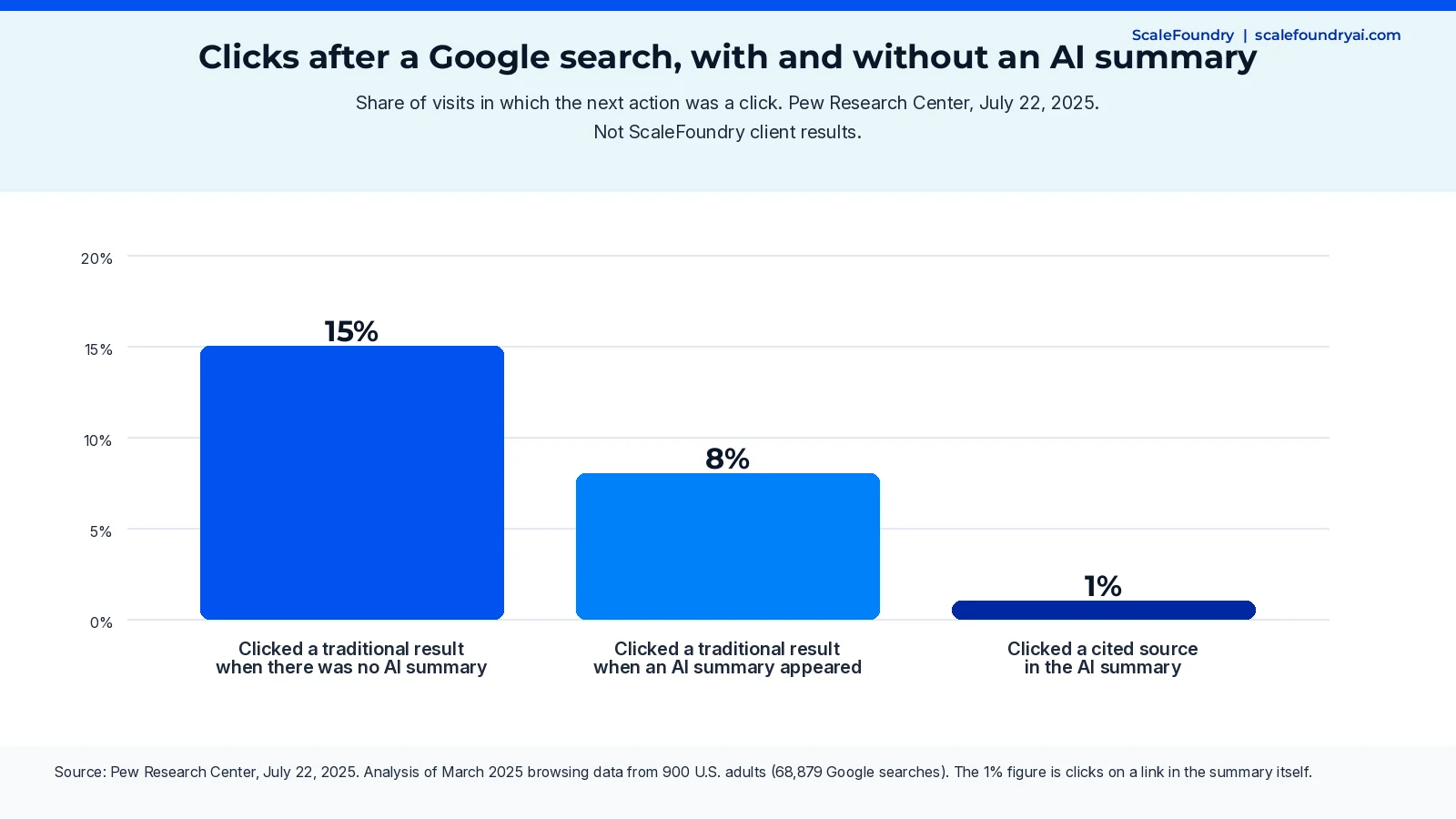
What happens after the answer appears matters just as much. Pew Research Center studied this in a July 22, 2025 short read. The analysis used March 2025 browsing data from 900 U.S. adults, covering 68,879 Google searches. About 18% of those searches produced an AI summary.
When an AI summary appeared, users clicked a traditional search result in 8% of visits. When there was no summary, they clicked a traditional result in 15% of visits. Clicks on a link inside the summary itself were rare: 1% of visits to pages with a summary. Users also ended their browsing session more often after a page with a summary (26%) than after a page without one (16%).
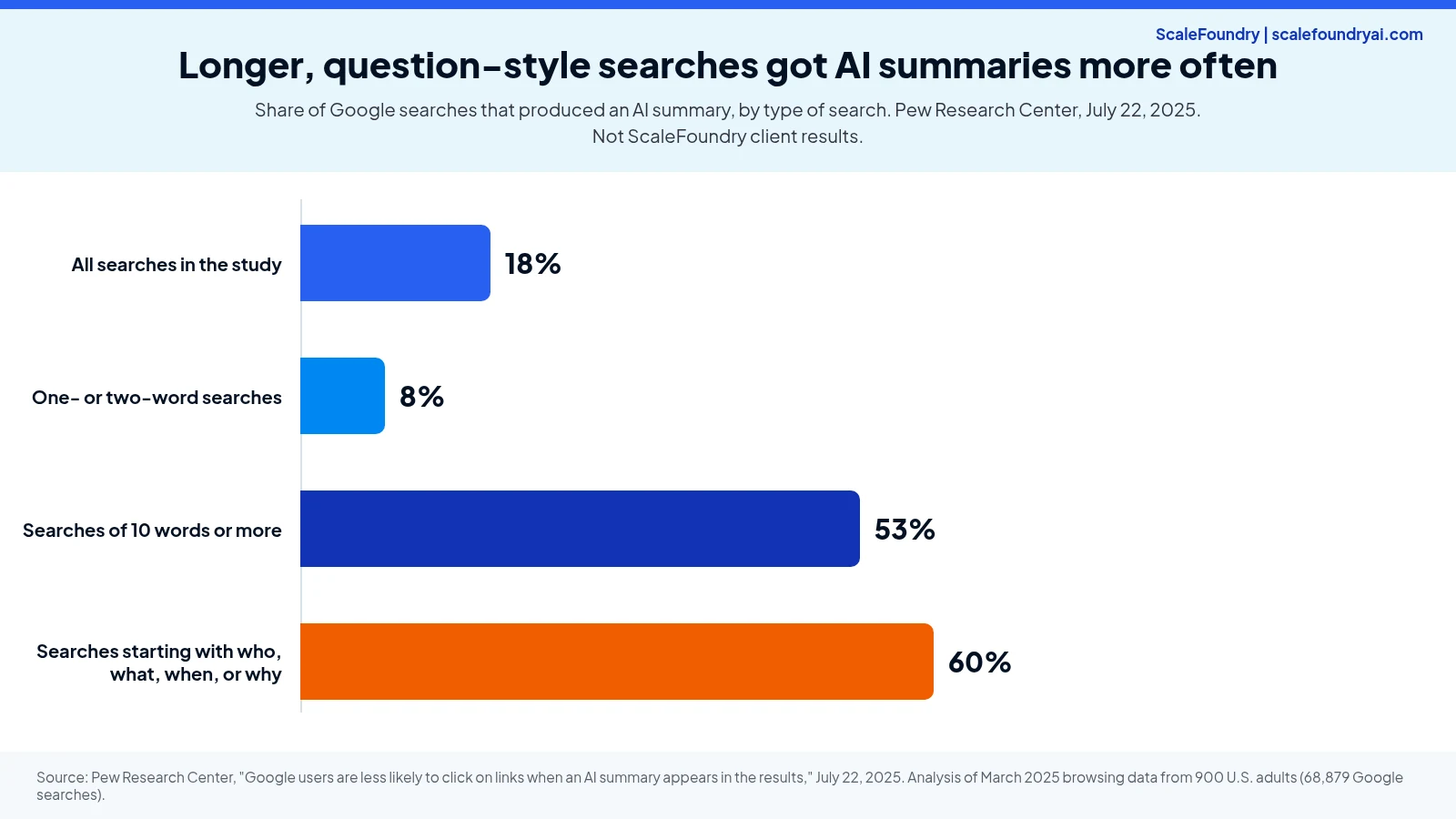
Pew also found that longer, question-shaped searches were more likely to trigger a summary. Only 8% of one- or two-word searches produced one, compared with 53% of searches of 10 words or more, and 60% of searches that began with words such as who, what, when, or why.
For a contractor, the practical point is simple. A homeowner who types "emergency plumber near me" or asks "who can inspect a roof in Prince George's County after a storm" may get an answer on the results page, or in a chat tool, before they ever open your site. If you do show up, they still have to reach you. A click you earned can still be lost to a missed call, which is why our guide to missed-call text back for contractors belongs with this topic.
Is SEO still relevant if people use ChatGPT or Google AI Overviews?
Yes. Google's documentation says SEO best practices remain relevant for AI features such as AI Overviews and AI Mode, and that there are no extra requirements to appear in those features. From Google's point of view, work aimed at AI search is still SEO. A page still has to be indexed and eligible to show in Search with a snippet.
That is not an agency opinion. It is in Google's AI features and your website documentation. The same page says that meeting the requirements does not guarantee that Google will crawl, index, or serve a page. Indexing is not a promise.
The longer generative AI optimization guide repeats the point and adds a warning about third-party "AEO" or "GEO" advice. Google tells site owners to check that advice against official guidance. It also says that for Google Search you can ignore tactics like "chunking" content, creating AI text files such as llms.txt, or chasing inauthentic mentions.
This is good news for a small shop. You do not have to rebuild your site around a new acronym. You do have to get the basics right, and you should write pages that actually help the person who lands on them.
How do Google AI Overviews and AI Mode work?
They use Google's search systems to find current pages, then write a short answer and show links to supporting sites. Both may run several related searches, which Google calls query fan-out, to gather more material. AI Overviews appear only when Google decides they add something to regular results, so they often do not show.
Google's AI features documentation explains the pieces in plain language. The system pulls relevant, up-to-date pages from the Search index, reviews information from those pages, and generates a response with clickable links to supporting sites. Google's own fan-out example is a lawn-care question that branches into searches about herbicides, non-chemical options, and prevention.
AI Mode and AI Overviews may use different models and techniques, so the links they show can differ. Because AI Overviews are only meant to appear when they add something, many searches will still look like a regular results page.
To be eligible as a supporting link, a page must be indexed and eligible to be shown in Google Search with a snippet. There are no additional technical requirements. Google also says to keep important content in text, keep structured data consistent with the visible text, give visitors a good page experience, and keep your Business Profile information up to date.
How can a small business show up in AI answers?
Start with the same work that helps you in regular search. Get your important pages indexed. Put the answers in plain text, not only in images. Keep your business name, phone, hours, and service area consistent, including on your Google Business Profile. Answer common questions clearly near the top of the page. Nobody can guarantee a citation.
A practical list, in line with Google's guidance:
- Confirm that Google can crawl your site, and that important pages are not blocked or marked noindex by mistake. Use Search Console once you have access.
- Publish useful service pages that match the work you actually do. A roofing contractor page should talk about inspections, repairs, and the areas you serve. An HVAC page should cover no-heat and no-cool calls. Do not write generic pages that could belong to any trade in any city.
- Put a short, direct answer under the question a customer would ask. Then add the detail. That helps people, and it gives a search feature a passage it can use.
- Write sentences that can stand on their own. Name the business, the service, and the place, so a quoted line still makes sense out of context.
- Keep your name, service area, phone number, and hours identical on your site, your Google Business Profile, and any directories you use. Google's generative AI guide says Business Profile information can help your services show in AI responses as well as in other Search results.
- Use structured data only for what is visible on the page. It is not required for Google's AI features, but it can still help with rich results in regular Search. If you want it set up correctly, see our schema markup service.
- Skip gimmicks that Google says you can ignore for Search: special AI-only files, "chunking" pages into tiny pieces, rewriting copy just for machines, or chasing inauthentic mentions.
ChatGPT, Perplexity, and other assistants are not Google, and they do not all use the same sources or the same rules. The common ground is still a clear, public page with accurate facts, plus mentions on other trustworthy sites when those mentions are real. To have this done for you, see our AI search optimization service.
What should a DMV contractor do first?
Fix the basics on your website and Google Business Profile before you buy a separate GEO package. Make sure Google can crawl your service pages. Write clear answers about the work you do, the areas you serve in DC, Maryland, and Virginia, and how to reach you. Then test a few real customer questions and note whether you are named.

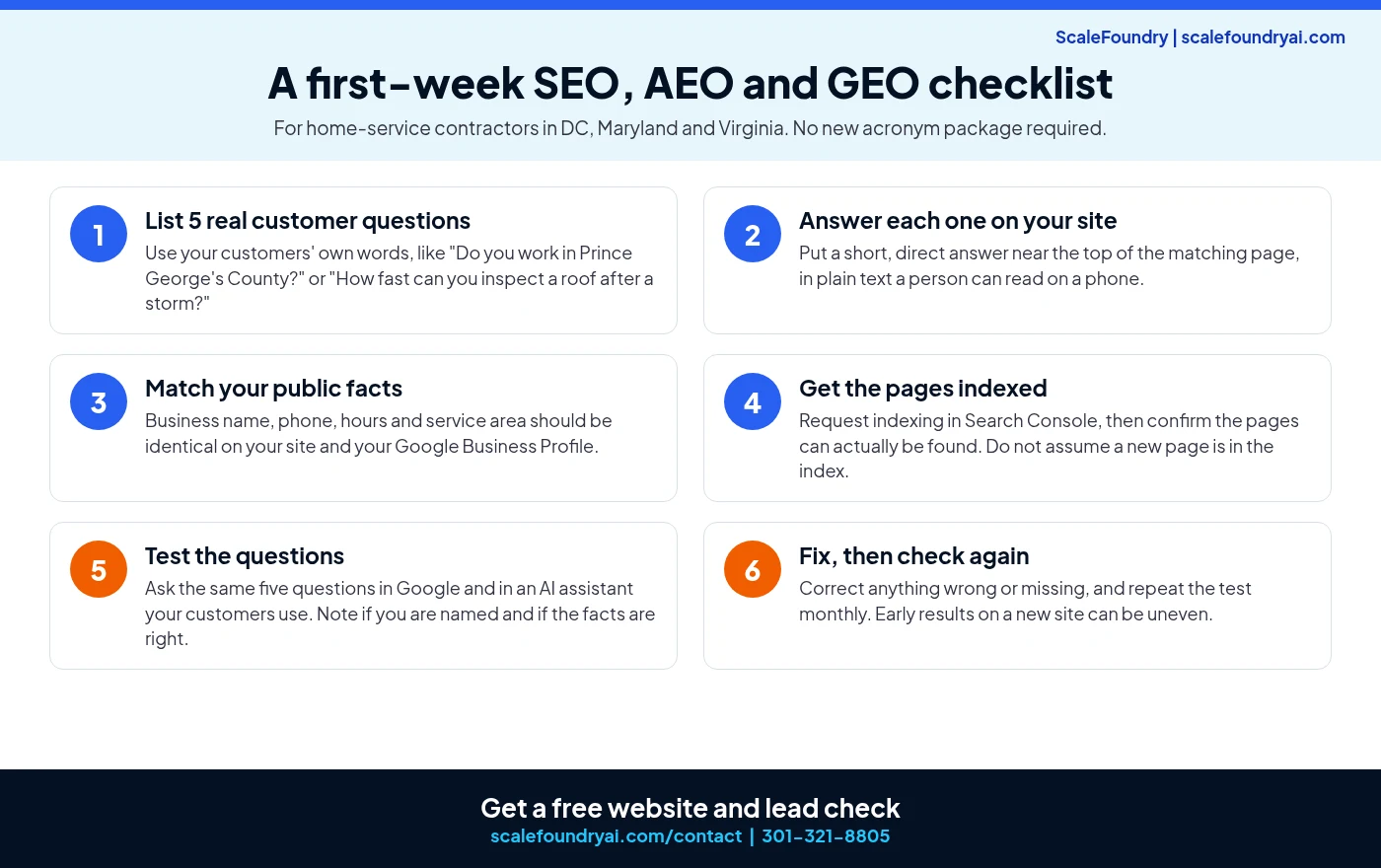
A first-week checklist for a shop in Upper Marlboro and Bowie, across Prince George's County, or anywhere in our DC, Maryland, and Virginia service areas:
- Write down five questions customers actually ask, such as "Do you work in Prince George's County," "How fast can you inspect a roof after a storm," or "Are you available after hours." Use your own wording.
- Make sure each question has a clear answer on your site, near the top of the relevant page, in text a person can read on a phone.
- Check that the number and hours on your site match the number and hours on your Google Business Profile. Those are the public facts a customer and an AI tool will compare.
- Request indexing for those pages in Search Console when you have it, and wait until they can be found in a site: search or in the page indexing report. Do not assume a new page is already in the index.
- Ask the same five questions in Google, and again in an AI assistant you actually see customers using. Write down whether your business is named, whether the facts are correct, and which page, if any, was cited.
- Fix anything that is wrong or missing, then check again later. Early results on a new or little-known site can be uneven.
This work also supports the rest of how leads are captured and booked. Visibility only helps if someone can reach you and get a time on the calendar. For a wider look at contractor lead follow-up, including missed-call text back, online booking, and Google review requests, start on the services page. If you want to compare what each level of help includes, see ScaleFoundry plans and pricing.
How do you measure whether this is working?
Use Google Search Console for clicks, impressions, and position in regular search. For Google's AI features, use the Generative AI performance report, which Google says was rolled out to all websites worldwide as of August 31, 2026. For ChatGPT and similar tools, keep a simple log of the questions you ask and whether your business is named or linked.
Google documents the Generative AI performance report in Search Console Help. The report shows how your site performs in generative AI features on Google Search, including AI Overviews and AI Mode. Google notes that you may not see the report until a site has enough impressions in those features.
A monthly prompt log is not a formal rank tracker, but it is honest. Use the same questions each time, record the date, the tool, and whether you were named or cited, and do not treat a single lucky answer as proof. For a new site, it is normal to see no unbranded mentions at first.
Get a free website and lead check
Get a free website and lead check. We'll look at how your calls, texts and estimates are handled today and tell you which plan fits. If none of them fit, we'll say so.
Rather talk now? Call 301-321-8805, Mon-Fri 8am-6pm ET.
ScaleFoundry is a service-area business based in Upper Marlboro, Maryland, serving home-service contractors in DC, Maryland, and Virginia, plus remote clients nationwide.
FAQ
What is SEO, AEO, and GEO?
SEO helps your pages appear in search results so people can click through to your site. AEO, or answer engine optimization, aims to have your content used as a direct answer, such as a featured snippet or an AI Overview. GEO, or generative engine optimization, aims to have your business named or cited in an AI-written answer.
How do SEO, AEO, and GEO differ?
They differ in the result they aim for, not in a separate skill set. SEO is about ranking a page in a list of results. AEO is about being used as the short, direct answer. GEO is about being named or cited when an AI system writes a reply. All three rely on clear, crawlable pages with consistent facts.
Is SEO still relevant if people use ChatGPT or Google AI Overviews?
Yes. Google's documentation says SEO best practices remain relevant for AI features such as AI Overviews and AI Mode, and that there are no extra requirements to appear in those features. From Google's point of view, work aimed at AI search is still SEO. A page still has to be indexed and eligible to show in Search with a snippet.
Do I need an llms.txt file or special schema to show up in Google's AI answers?
No. Google says you can ignore AI text files such as llms.txt for Google Search, and that there are no additional technical requirements to appear in AI Overviews or AI Mode. Structured data is not required for AI features, but it should still match what is visible on the page.
How can a small business show up in AI answers?
Start with the same work that helps you in regular search. Get your important pages indexed. Put the answers in plain text, not only in images. Keep your business name, phone, hours, and service area consistent, including on your Google Business Profile. Answer common questions clearly near the top of the page. Nobody can guarantee a citation.
What should a DMV contractor do first?
Fix the basics on your website and Google Business Profile before you buy a separate GEO package. Make sure Google can crawl your service pages. Write clear answers about the work you do, the areas you serve in DC, Maryland, and Virginia, and how to reach you. Then test a few real customer questions and note whether you are named.
About the author
Ray Donato is the founder of ScaleFoundry, an AI marketing and automation agency for home-service contractors in DC, Maryland, and Virginia. He has 24 years of cybersecurity and communications experience. He works with owners who want a plain explanation of how customers find them, and a follow-up system that can catch the job once they do.
Sources
- Google Search Central, "Google's Guide to Optimizing for Generative AI Features on Google Search." https://developers.google.com/search/docs/fundamentals/ai-optimization-guide (checked November 23, 2026)
- Google Search Central, "AI Features and Your Website." https://developers.google.com/search/docs/appearance/ai-features (checked November 23, 2026)
- Google Search Console Help, "Generative AI performance report (Search)." https://support.google.com/webmasters/answer/16984139 (checked November 23, 2026)
- OpenAI, "DevDay 2026 recap," September 29, 2026. https://openai.com/index/devday-2026-recap/
- Google, Sundar Pichai, I/O 2026 remarks, May 19, 2026. https://blog.google/innovation-and-ai/sundar-pichai-io-2026/
- Google, Alphabet Q3 2026 earnings remarks, October 28, 2026. https://blog.google/company-news/inside-google/message-ceo/alphabet-earnings-q3-2026/
- Pew Research Center, Athena Chapekis and Anna Lieb, "Google users are less likely to click on links when an AI summary appears in the results," July 22, 2025. https://www.pewresearch.org/short-reads/2025/07/22/google-users-are-less-likely-to-click-on-links-when-an-ai-summary-appears-in-the-results/
- Aggarwal et al., "GEO: Generative Engine Optimization," arXiv:2311.09735, 2023. https://arxiv.org/abs/2311.09735
Serving Upper Marlboro? See contractor marketing in Upper Marlboro, MD.
Want this set up for your crew?
Get a free website and lead check